ChatGPT is becoming more than a platform for asking questions, generating content, and researching products. It is also developing into a new advertising channel where businesses can reach potential customers while they research, compare products, and make purchasing decisions.
ChatGPT Ads give advertisers an opportunity to reach people during these conversations rather than relying exclusively on traditional search queries or social media feeds. OpenAI has introduced an advertising platform with campaign management, targeting, bidding, and conversion measurement capabilities.
For businesses, marketers, and advertising agencies, this creates an opportunity to explore AI-powered advertising. However, questions remain about how the platform works, where advertisers can access it, what ChatGPT ads look like, and whether independent businesses can launch campaigns.
This guide explains everything you need to know about OpenAI Ads, including ChatGPT Ads Manager, login instructions, advertising examples, European availability, pricing, and what businesses should consider before investing.
What Are ChatGPT Ads?
ChatGPT Ads are sponsored advertisements displayed within the ChatGPT experience. They allow businesses to promote products and services to users whose conversations indicate that their offerings may be relevant.
Unlike traditional search advertising, where an advertiser typically targets specific keywords, ChatGPT advertising considers conversational context and user intent.
For example, imagine someone asks ChatGPT to recommend project management software for a remote team of 20 employees. The response might explain the features to consider, compare different software options, and provide recommendations. A relevant sponsored advertisement for a project management platform may appear alongside the response.
The advertisement is separate from ChatGPT’s organic answer and is clearly identified as sponsored content.
OpenAI began testing ChatGPT Ads in the United States in February 2026. The platform has since expanded into additional international markets, with self-service advertising becoming available in eligible countries.
This development gives businesses another way to reach potential customers through conversational AI.
How Do ChatGPT Ads Work?
ChatGPT advertising is built around the context of a conversation rather than relying exclusively on conventional keyword matching.
When someone asks a question, ChatGPT’s advertising system evaluates different signals to determine whether an advertisement is relevant. These include the current conversation, the advertiser’s landing page, the ad headline, description, targeting selections, and advertiser-provided context hints.
The system then determines which eligible advertisement is suitable for the conversation.
For advertisers, this means campaign relevance depends on more than selecting popular search terms. The product, advertising message, and destination page must align with what the potential customer is trying to accomplish.
For example, a person researching accounting software for a small business may be more receptive to an advertisement for bookkeeping software than someone asking about general accounting principles.
Depending on the campaign setup and available account capabilities, advertisers can work with different campaign objectives, including brand awareness, website traffic, and conversions.
The available buying options include cost per thousand impressions (CPM) and cost per click (CPC).
This makes ChatGPT advertising relevant to both brand awareness and performance marketing.
ChatGPT Ads Example: What Do the Advertisements Look Like?
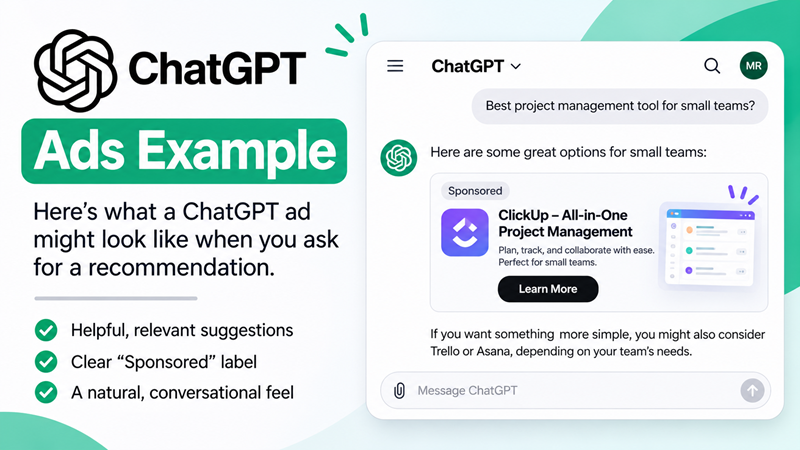
One of the easiest ways to understand ChatGPT advertising is to look at how a sponsored placement fits into an actual conversation.
Consider this example.
A user asks:
“I’m looking for an affordable CRM for a small business with five employees. Which platforms should I consider?”
ChatGPT provides an answer explaining CRM features, pricing considerations, and suitable platforms. A sponsored advertisement for a CRM provider could appear as a separate placement.
The advertisement might contain the advertiser’s business name, an advertising headline, a short product description, and a link to the advertiser’s landing page.
The advertisement is clearly marked, allowing users to distinguish paid placements from ChatGPT’s responses.
This is an important difference between ChatGPT Ads and conventional search advertising. Instead of displaying an advertisement alongside a list of search results, the platform can introduce a relevant business within a conversation where a user is already exploring a particular need.
A Practical ChatGPT Ads Example for a SaaS Business
Imagine a company selling email marketing software.
Rather than advertising a generic message such as “Get the Best Email Marketing Software,” the business could create an advertisement explaining how its platform helps small businesses automate campaigns, manage subscribers, and track email performance.
The advertisement becomes relevant when users are researching email marketing solutions or comparing automation platforms.
However, appearing in a particular conversation is not guaranteed. ChatGPT’s advertising system considers multiple relevance signals, advertiser bids, and campaign eligibility.
What Is ChatGPT Ads Manager?
ChatGPT Ads Manager is OpenAI’s advertising management platform. It provides businesses with a central interface for creating, launching, managing, and measuring their ChatGPT advertising campaigns.
It serves a similar purpose to Google Ads or Meta Ads Manager, although its advertising environment and delivery system are different.
Advertisers can use the platform to manage campaign setup, advertising creatives, budgets, campaign objectives, and performance reporting.
OpenAI has been developing Ads Manager as a self-service platform, making it possible for eligible businesses to create and manage campaigns without relying entirely on a sales representative or advertising partner.
The platform is particularly relevant to SaaS companies, ecommerce businesses, advertising agencies, technology companies, and professional service providers.
ChatGPT Ads Manager Login: How to Access Your Account
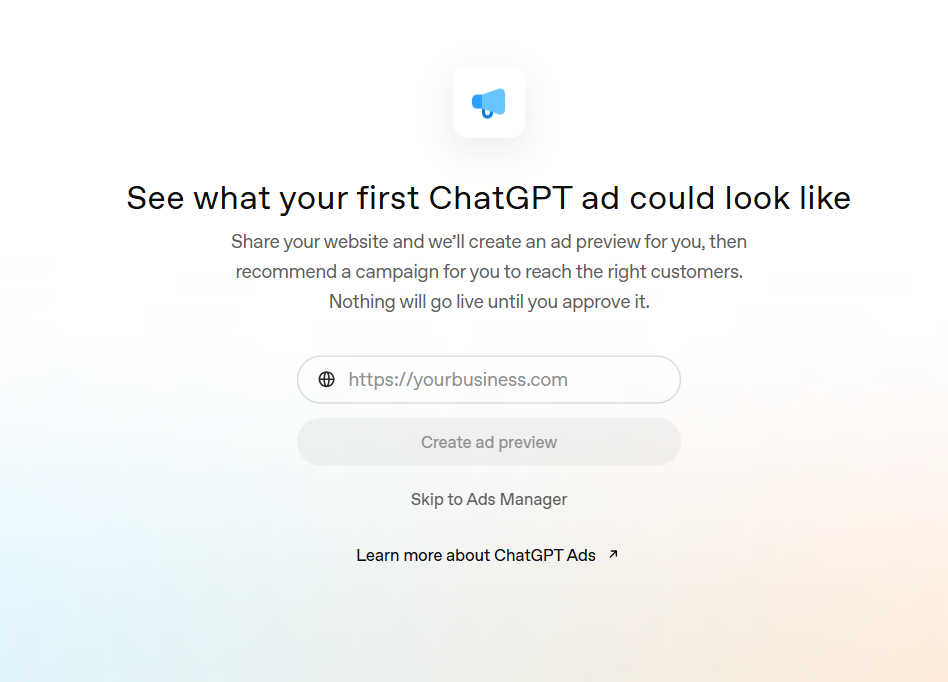
If you want to access the advertising platform, use the official OpenAI Ads website.
Official website
The account setup process involves the following steps:
- Visit OpenAI Ads Manager.
- Select Sign up to create an advertiser account or Login if you already have one.
- Sign in using your OpenAI account or create a new account.
- Follow the onboarding instructions to set up your advertiser account.
- Add your website, business information, and billing details as requested.
- Create your first campaign or enter Ads Manager to configure it later.
If your business already has an advertiser account, ask the account administrator to invite you rather than creating another account.
Creating an account does not automatically guarantee access to campaign management. OpenAI checks whether the country where your advertising business is legally registered is eligible for self-service access.
ChatGPT Ads Europe: Which Countries Can Advertise?
European businesses are among the advertisers gaining access to ChatGPT’s advertising platform.
OpenAI announced its expansion into 31 European markets in August 2026. The initial rollout provided access through OpenAI’s advertising team, agency partners, and technology partners.
On August 31, 2026, OpenAI announced that self-service Ads Manager access was available across those European markets.
Some of the countries included are Germany, France, Spain, Italy, Sweden, Norway, Denmark, the Netherlands, and Austria.
This means businesses in eligible European countries can explore advertising directly through OpenAI’s platform.
However, advertisers should distinguish between the country where they want to reach customers and the country where their business is legally registered.
OpenAI’s self-service eligibility requirements are based on the legal entity responsible for advertising and billing. Simply targeting European customers does not establish eligibility if the advertiser’s registered business is based elsewhere.
OpenAI Ads: What Makes Them Different From Google Ads?
OpenAI Ads and Google Ads both help businesses reach potential customers, but they approach advertising from different angles.
Google Ads primarily connects advertisements with search queries, keywords, audiences, and other targeting signals. ChatGPT Ads introduces another layer by considering the context of a user’s conversation.
For example, someone searching Google for “best accounting software” may encounter several sponsored search listings.
Someone asking ChatGPT, “Which accounting software can help my small business reconcile bank transactions and prepare monthly financial reports?” is communicating a more detailed requirement.
A relevant advertisement can potentially reach that person while they are evaluating solutions.
This creates an interesting opportunity for advertisers because conversational AI can reveal more about what someone needs than a short search query might communicate.
However, this does not mean ChatGPT Ads will automatically outperform Google Ads. The platforms have different audiences, placements, buying models, and conversion paths.
Businesses should evaluate them using actual campaign performance rather than assuming that a newer advertising channel will deliver better results.
ChatGPT Ads Agency: Do You Need an Agency to Advertise on OpenAI?
Businesses do not necessarily need an advertising agency to launch ChatGPT campaigns. OpenAI’s self-service Ads Manager allows eligible advertisers to create and manage campaigns directly.
However, working with a ChatGPT Ads agency can be useful for companies that need help with campaign strategy, creative development, customer research, conversion tracking, and performance optimization.
This is particularly relevant for businesses that already advertise on Google, Meta, or LinkedIn but want to experiment with conversational AI advertising.
An experienced agency should understand how to adapt traditional advertising strategies to ChatGPT’s conversational environment.
For example, rather than simply transferring an existing Google Ads campaign into ChatGPT, an agency should reconsider the advertising message, customer intent, landing page, and conversion journey.
It should also understand how to measure the results of a new advertising channel without relying exclusively on impressions or clicks.
What Should You Look for in a ChatGPT Advertising Agency?
Before hiring an agency, evaluate its understanding of:
- AI advertising strategy: Can it identify relevant conversational contexts for your products and services?
- Campaign management: Can it create, monitor, and optimize campaigns?
- Creative development: Can it produce clear, benefit-focused advertising messages?
- Conversion tracking: Can it implement the OpenAI Pixel or Conversions API and measure business outcomes?
- Reporting: Can it distinguish advertising engagement from actual leads, sales, and revenue?
One important consideration is experience. Since ChatGPT Ads is still a relatively new advertising channel, be cautious about agencies claiming guaranteed results or presenting unverified performance benchmarks.
Ask for actual campaign data, a clear testing methodology, and an explanation of how they measure success.
ChatGPT Ads Pricing: CPC and CPM
At launch, Ads Manager added CPC bidding alongside the original CPM model, and OpenAI says both remain available. Clicks campaigns use cost per click, while Reach campaigns use cost per thousand impressions.
On numbers, the same third-party guide reports a recommended starting bid of $3 to $5 per click and a default CPM cap of $60, though observed CPMs ran closer to $25. It also notes the early pilot reportedly demanded a $50,000 commitment, while there is no minimum spend today. The auction weighs relevance as well as price, which means a sharp context hint can beat a bigger bid. Pricing on a young platform moves quickly, so treat every figure as a range and verify it inside the dashboard.
Once clicks start arriving, you will need analytics and reporting software. The Marketing and SEO tools on Techtoric are a sensible place to compare options.
How to Create a Successful ChatGPT Ads Campaign
Launching a campaign is only the first part of the process. The more important question is whether the advertisement reaches the right people and generates meaningful business results.
1. Define Your Advertising Objective
Start by identifying what you want the campaign to achieve.
A SaaS company might want to generate free-trial registrations, while an ecommerce business may prioritize product purchases. A professional services company might focus on qualified enquiries.
Your objective should determine the campaign structure and the metrics you use to evaluate performance.
2. Understand Your Target Customers
Think about the questions potential customers ask before choosing your product.
A cybersecurity company, for example, might want to reach businesses researching endpoint protection, network security, or vulnerability management.
These conversational needs provide useful direction when preparing advertiser context hints.
3. Write Specific Advertising Messages
Generic advertising messages are unlikely to communicate enough value.
Instead of writing “Discover Our Business Software,” explain what the product does, who benefits from it, and which problem it solves.
OpenAI’s advertising guidance emphasizes specific, clear, benefit-focused messaging.
4. Optimize Your Landing Page
An advertisement may attract a click, but the landing page determines what happens next.
Make sure your page clearly explains the product, communicates its benefits, provides relevant evidence, and offers a straightforward next step.
For businesses advertising software, a dedicated product landing page is often more appropriate than sending every visitor to the homepage.
5. Measure and Improve Performance
Track impressions, clicks, conversions, and the quality of leads generated.
OpenAI provides measurement options including its advertising pixel and Conversions API. These help advertisers understand what happens after users interact with their campaigns.
Do not judge performance using clicks alone. A campaign generating fewer clicks but more qualified enquiries may deliver greater commercial value.
Practical Lessons Before You Spend
Treat the first 30 days of your ChatGPT ads test as research. One guide suggests starting with a Clicks objective and a daily budget of $50 to $100, which is enough to gather signal over two to three weeks without overcommitting. Resist the urge to tweak in week one. Compare which context hints produce clicks, which creatives win, and whether the traffic converts once it lands.
Install the conversion pixel before your ChatGPT ads go live so you see more than clicks. Also read OpenAI’s ad policies early. Third-party sources report restrictions on categories such as dating, financial services, health claims and political advertising, but policies change, so confirm against the official text rather than any blog, this one included.
Finally, remember that paid placement is only half of AI visibility. Brands also earn mentions organically, and the AI tools category on Techtoric is useful for tracking how that landscape shifts.
ChatGPT Ads and User Privacy: What Advertisers Should Know
Advertising within an AI conversation raises important questions about privacy and how personal information is handled.
OpenAI states that advertisements do not influence ChatGPT’s answers. Ads operate separately from the system generating responses, and advertisers cannot pay to change or influence those answers.
OpenAI also states that it keeps conversations private from advertisers and does not sell user data to advertisers.
Advertisers receive advertising measurement information rather than unrestricted access to users’ private conversations.
This distinction is important because conversational advertising depends on relevance, but that does not mean advertisers receive transcripts of the conversations that trigger ad placements.
For marketers, the practical takeaway is that campaign planning should focus on the business’s offering, advertising creative, landing page, and measurable campaign outcomes rather than attempting to obtain private conversation data.
ChatGPT Ads vs. SEO: Should Businesses Invest in Both?
Paid advertising and organic visibility serve different purposes, and businesses should not treat them as competing strategies.
ChatGPT Ads provides a paid opportunity to reach potential customers during relevant conversations. SEO focuses on earning organic visibility through search engines and other discovery platforms.
Both can contribute to customer acquisition, but they require different approaches.
For example, a software company can use ChatGPT Ads to promote its product to people researching business software. At the same time, its SEO strategy can target informational and commercial searches such as “best CRM software for small businesses” and “how to automate customer relationship management.”
There is also an important connection between SEO and AI discovery.
Businesses should maintain accurate product information, publish useful comparison pages, demonstrate expertise, and build a website that clearly communicates what they offer. These activities can support organic discovery across search engines and AI-powered platforms.
For technology businesses, this also means keeping product descriptions, pricing information, documentation, and landing pages consistent.
However, advertising and organic visibility should be measured separately. A paid placement is not an organic recommendation, and investing in ChatGPT Ads does not guarantee that ChatGPT will recommend a business in its answers.
What Is the Future of OpenAI Advertising?
ChatGPT Ads represents a developing advertising channel that connects commercial messages with conversational discovery.
The opportunity is particularly interesting because users often explain their requirements in considerable detail when interacting with AI assistants.
Someone looking for a laptop might specify their budget, preferred operating system, intended use, and technical requirements in a single conversation. Someone researching business software might explain their team size, existing tools, and operational challenges.
This provides a different environment for advertising compared with conventional keyword-based campaigns.
OpenAI is also expanding the infrastructure around its advertising platform. Its developments include conversion measurement, additional creative formats, audience capabilities, and programmatic advertising tools.
For advertisers, the next challenge will be understanding how to use these capabilities effectively while maintaining acceptable acquisition costs.
It is too early to assume that ChatGPT Ads will replace existing advertising channels. However, businesses that understand conversational intent and build strong measurement processes will be better positioned to evaluate the opportunity as the platform develops.
Frequently Asked Questions About ChatGPT Ads
Is ChatGPT introducing advertisements?
Yes. OpenAI began testing advertisements in ChatGPT in February 2026. The advertising platform has since expanded into additional countries and supports self-service campaign management through Ads Manager in eligible markets.
How do I log in to ChatGPT Ads Manager?
Visit OpenAI Ads Manager, select Login, and sign in using your OpenAI account credentials. New advertisers can select Sign up and follow the account setup instructions.
Is ChatGPT Ads available in Europe?
Yes. OpenAI expanded ChatGPT Ads to 31 European markets in August 2026. Self-service access through Ads Manager became available across those markets on August 31, 2026. Advertisers must meet the relevant country eligibility requirements.
Can Nigerian businesses advertise on ChatGPT?
Yes. Nigeria appears on OpenAI’s current self-service Ads Manager availability list. Nigerian businesses can sign up and explore access, subject to account approval, legal entity, and billing requirements.
Do I need an agency to run OpenAI Ads?
No. Eligible businesses can manage their campaigns through OpenAI’s self-service Ads Manager. However, an agency can help with campaign strategy, advertising creatives, conversion tracking, and performance optimization.
Do ChatGPT Ads influence the answers generated by ChatGPT?
No. OpenAI states that advertisements operate separately from ChatGPT’s answer generation system. Advertisers cannot pay to influence organic answers, and sponsored placements are clearly identified.
Can I advertise my SaaS product on ChatGPT?
Yes. SaaS businesses can use ChatGPT Ads to promote software subscriptions, business applications, productivity platforms, and other eligible products. Campaign messaging should explain the product’s benefits and target relevant customer needs.
Are ChatGPT Ads available to small businesses?
Eligible small businesses can use the self-service advertising platform. They do not necessarily need to work with a large advertising agency. However, they should establish a suitable campaign budget and conversion measurement process before launching.
Final Thoughts
ChatGPT Ads introduces a new way for businesses to reach potential customers through conversational AI. Rather than depending exclusively on search keywords or social media targeting, advertisers can explore opportunities to connect with people while they research products, compare services, and evaluate solutions.
OpenAI’s Ads Manager makes this opportunity more accessible to eligible businesses, including advertisers in Europe and Nigeria.
However, the platform is still developing. Businesses should approach it with a clear advertising objective, relevant messaging, a well-optimized landing page, and reliable conversion tracking.
If you are a marketer, business owner, or agency professional, now is a good time to understand how conversational advertising works and assess whether it fits your customer acquisition strategy.
Visit OpenAI Ads to check your eligibility and explore the advertising platform.